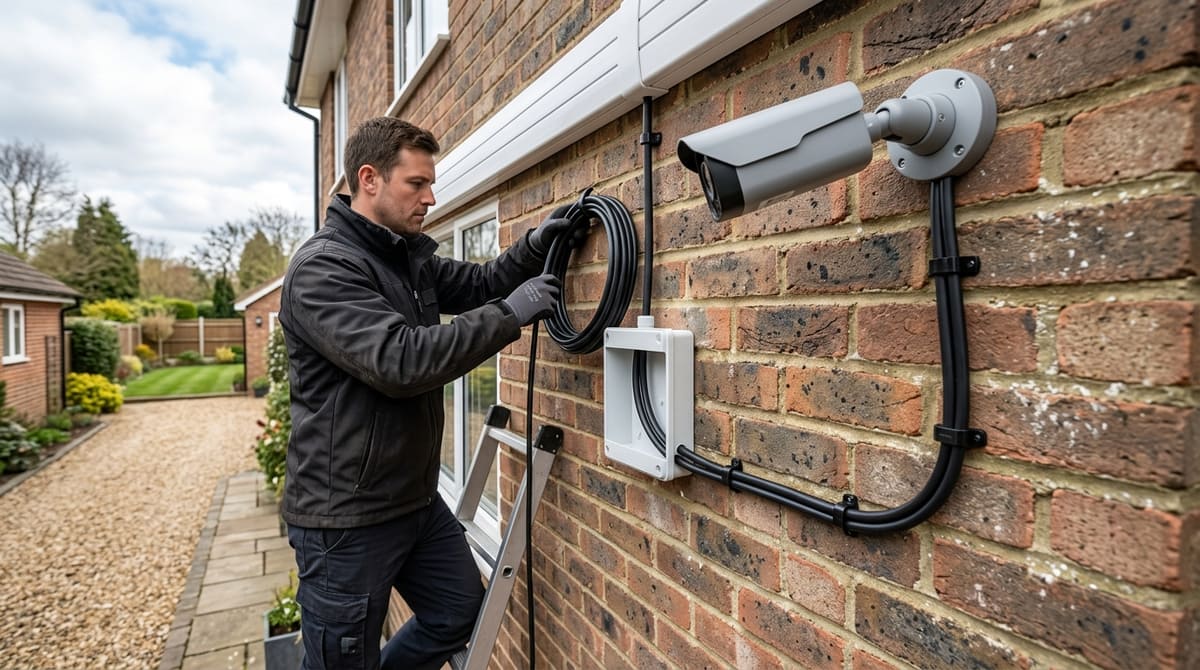
Yes, Cat6a can run outdoors, but only if it is genuinely outdoor-rated cable with a jacket suited to the exposure it will see, not an indoor-grade PVC or LSFH jacket, and only if the route protects it. UV-resistant polyethylene (PE) is a common choice, as on the Connectix TruLAN Cat6A F/FTP Outdoor Cable. Other outdoor-rated jackets exist, so check the manufacturer's datasheet for the approved route.
For buried runs, pulling the cable through duct or conduit is the more cautious option. Direct burial is only appropriate when the datasheet explicitly says so. Get the jacket and the route right and Cat6a will carry 10GBASE-T to 100 m, which leaves plenty of headroom for a CCTV camera.
What is outdoor Cat6a cable, and can you run it outside?
Outdoor Cat6a is a 500 MHz network cable with a weather-resistant jacket, such as UV-resistant polyethylene, and yes, it is made to run outside, but the route (aerial, ducted or buried) must suit the specific cable.
Cat6a is the "augmented" sixth category of twisted-pair Ethernet cable. It supports 10GBASE-T to 100 m, against 250 MHz for Cat6 and 100 MHz for Cat5e.
What "outdoor" actually means
The difference is mostly the jacket. Outdoor cable often uses UV- and abrasion-resistant polyethylene (PE) where indoor cable uses PVC or LSFH. As general guidance, indoor Cat6 left in daylight is a risk, because those jackets aren't built for sustained sun exposure.
Outside-plant (OSP) cable is the formal version of this. Leviton specifies its OSP Cat6A for outside applications, either aerial or buried in conduit or duct, where building-to-building interconnections are needed. Check the jacket and the approved route separately from the Cat6a performance rating. For CCTV, a PE-sheathed example is the Connectix TruLAN Cat6A F/FTP Outdoor Cable.
Outdoor Cat6 cable diameter
Diameter varies by construction. One UK listing for a shielded S/FTP Cat6a cable quotes 8 mm.
Treat that as indicative only. Take the outer diameter from the datasheet of the exact cable you are buying before you choose glands, conduit or RJ45 boots.
Which outdoor Cat6a cable should you choose for CCTV?
Choose by where the cable runs: a PE-sheathed F/FTP cable for exposed external runs on structures, and a duct-grade 23AWG cable for underground installations. Both are shielded, and a third route, direct burial, needs its own check.
What to check on any datasheet
- Shielding: F/FTP has foil around each pair plus an overall foil screen. F/FTD is the construction named on our duct-grade listing. U/FTP screens the pairs individually but has no overall screen, so compare each manufacturer's construction notes for noisy sites.
- Conductors: Solid copper generally suits fixed runs, while stranded cable tends to be found in patch leads as a flexibility trade-off. Verify the conductor construction of the specific cable you choose rather than assuming it.
- 23AWG: A thicker conductor lowers resistance, which helps where PoE or PoE+ cameras sit at the far end of a long run. Confirm the result against your switch's PoE budget rather than assuming it.
- Sheath and route: The jacket rating and the route approval are separate questions from Cat6a performance. Check each against the manufacturer's datasheet.
Matching the route
For cabling on walls, brackets and poles, the Connectix TruLAN Cat6A F/FTP Outdoor Cable PE Sheath is listed with a polyethylene sheath for external installations and CCTV. The listing does not claim direct burial, so check the Connectix datasheet before putting it in the ground.
For underground runs, the Cat6A Duct Grade Cable 23AWG F/FTD Shielded is described as duct grade and suitable for underground and outdoor installations. It is listed as supporting 10 Gbps to 100 m and as PoE-ready. Check your termination hardware, such as RJ45 plugs or keystones, against the cable and connector datasheets so the screen stays continuous.
Direct burial is a separate decision. Leviton's OSP Cat 6A cable, for example, is specified for aerial installation or burial in conduit or duct. Neither product above is presented here as approved for direct burial, so confirm a burial rating with the manufacturer before laying either one without a duct.
To buy either cable, open a trade account with Euro CCTV.
Duct, conduit or direct burial: which is right for a CCTV run?
Use duct or conduit unless the cable's own datasheet explicitly says direct burial. Leviton's OSP Cat 6A cable is specified for outside runs, either aerial or buried in conduit or duct. Cat6A performance and route suitability are separate questions: the category describes the data performance, while the sheath and datasheet say where the cable can go.
| Method |
Sheath to look for |
Serviceability |
| Duct or conduit |
Outdoor or duct-grade sheath |
Best: a failed or damaged cable can be pulled out and replaced without re-digging |
| Direct burial |
Only a cable whose datasheet states direct burial |
Poor: a fault generally means excavating |
| Surface-clipped or aerial |
Outdoor-rated sheath, confirmed on the datasheet |
Easy to inspect and replace, but exposed to weather and knocks |
Our Cat6A Duct Grade Cable 23AWG F/FTD Shielded is a duct-grade, 23AWG, F/FTD shielded cable, described as suitable for outdoor and underground installations. It supports 10Gbps to 100m and is PoE-ready.
The Connectix TruLAN Cat6A F/FTP Outdoor Cable is foil-shielded with a polyethylene sheath, and is described for external installations, structured cabling and CCTV. Choose between the two by route: the duct-grade cable for a ducted underground run, the Connectix for an exposed external one. Neither description states direct burial, so check the datasheet before assuming either suits it.
Shield continuity, glands and fixings
Both cables are shielded, so the screen needs to stay continuous from the switch or patch panel to the camera. Use shielded connectors or a shielded patch panel, and follow the manufacturer's instructions on where the screen is bonded, as the right method depends on the cable construction and the equipment. An unterminated screen does little to reduce interference.
At the camera end, read the cable's outer diameter from the datasheet and pick a gland whose clamping range covers it. Outdoor jackets can be thicker than indoor cable, so a gland sized for a slimmer cable may not seal properly. Leave a drip loop below the gland so water runs off before it reaches the entry point.
In duct, pull on a draw cord and stay within the datasheet's pulling tension and minimum bend radius. On surface-clipped runs, space the clips as the manufacturer advises and avoid over-tightening, which can deform the cable. Cable-specific limits vary by model, so the datasheet is the authority.
Spare capacity at the first dig
Laying a spare duct, or at least a draw cord, while the trench is open avoids re-excavating when you add a camera or replace a damaged run. Ask your installer for it before the trench is backfilled.
The work itself is done by your own installer or electrician, as we supply the cable and the datasheet. If you need to check a specification before ordering, open a trade account at Euro CCTV.
How do you route and protect the cable on site?
Keep each run within 100 m, clip it at the right size without crushing the jacket, keep it away from mains where practical, and seal every open end against water.
Exposed run, duct or burial
Match the cable to the route, and check the jacket and route approval separately from the Cat6a performance rating.
For a run clipped to a wall or soffit, the Connectix TruLAN Cat6A F/FTP Outdoor Cable PE Sheath is described for external installations and CCTV, with a polyethylene sheath and foil-shielded pairs. For a ducted underground route, the Cat6A Duct Grade Cable 23AWG F/FTD Shielded is described as suitable for outdoor and underground installations.
Neither listing states direct burial, so confirm that on the datasheet before laying either without duct. Manufacturers differ here: Leviton's OSP Cat 6A cable is specified for aerial installation or burial in conduit or duct.
Distance and PoE
The duct grade Cat6A is listed for 10Gbps to 100 m and is described as PoE-ready. Treat 100 m as the ceiling for the whole channel, patch leads included. Conductor construction affects resistance, and therefore PoE headroom at the far end, so verify it on the datasheet for the cable you choose. Size the switch against the total camera load, not the per-port figure alone.
Interference
Shielded construction can help where a data run has to share a route with power cables. Where practical, keep data away from mains anyway, and ask your electrician about the segregation requirements for the site. A shield only works if the screen is terminated properly, with a continuous screen path from end to end. Check your connectors, jacks and termination hardware against the cable and connector datasheets, otherwise you have paid for shielding you are not getting.
Protecting the jacket and ends
- Abrasion: the outer jacket is the weather barrier, so keep it unabraded. Run it clear of sharp edges, brick arrises and metal brackets, or use grommets and conduit at those points.
- Clips: check the outer diameter on the datasheet and buy clips to match. A clip that is too tight deforms the cable, and one that is too loose lets it chafe in the wind.
- Open ends: cap the ends of spare lengths and any cut ends left waiting for termination, so water cannot get in.
- Temperature: check the operating and installation temperature range on the datasheet for your exact cable, as these vary between products. Do not assume one cable's quoted range applies to another.
Installers can open a trade account at Euro CCTV to see account pricing on these cables.
How do you terminate and weatherproof the connection at the camera?
If your outdoor Cat6a is solid core, terminate it on a shielded keystone, then seal the connection in a junction box with a drip loop.
Don't crimp solid core
If you're asking how to crimp outdoor Cat6 cable, the answer for solid-core cable is generally that you shouldn't. Many RJ45 plugs are made for stranded patch cable, and a rigid solid conductor can seat poorly in them. Outdoor runs such as the 23AWG S/FTP reel on Kenable's product page are listed as solid conductor. Some plugs are made for solid core, so check the connector datasheet.
Punch the cable down onto a keystone instead, then use a short patch lead into the camera.
Keep the screen continuous
Match the hardware to the cable. A shielded cable such as our Cat6A Duct Grade Cable 23AWG F/FTD Shielded needs a shielded keystone or shielded RJ45 so the screen is bonded at the termination. One unshielded part in the chain breaks the screen, and the shield then does very little.
Check the cable and connector datasheets to confirm the keystone or plug suits that cable's conductor construction and outer diameter. Follow the manufacturer's guidance on where the screen is earthed.
Keep water away from the RJ45
The RJ45 is not weatherproof, so it belongs inside the camera's junction box or a sealed enclosure. Bring the cable in through a gland, sealed around the sheath. Leave a downward drip loop just before the entry so water runs off the lowest point of the loop and not along the cable into the box.
Your own electrician or installer fits the kit. We supply equipment only, so follow the cable and camera datasheets.
Related products from our own range: