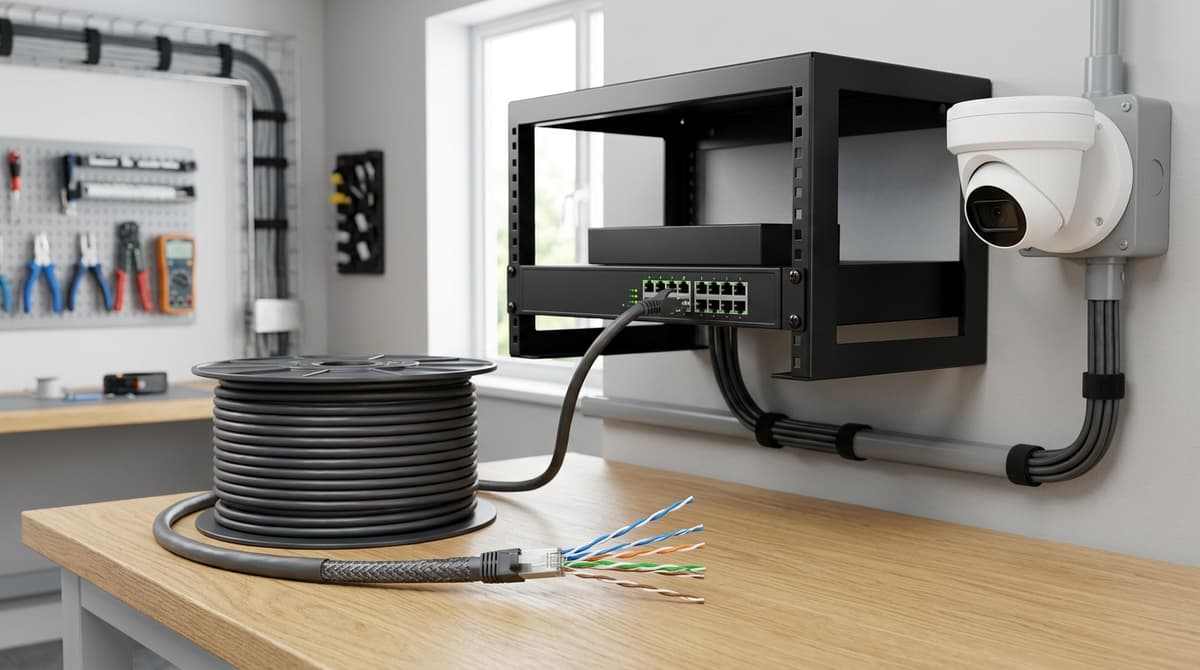
Run PoE camera drops on solid-core Cat6 rated for the environment it's actually in — U/UTP or F/UTP, outdoor-jacketed if it leaves the building. Keep stranded-core patch leads strictly to the rack and camera pigtail ends.
At 24AWG and 250MHz, Cat6 gives IP cameras plenty of headroom on data. The real reason it beats Cat5e on a CCTV job is copper mass and twist quality, which keep voltage drop in check over a full PoE run.
Mix that up, or bury an indoor-rated cable outdoors, and you're the one back up the ladder re-terminating a failed link within the year.
Best Cat6 Ethernet Cable for CCTV Installs in the UK: Choosing the Right Cable, Length and Build
The right cable for a PoE IP camera drop is solid-core Cat6, outdoor-rated if any part of the run leaves the building, and cut to the actual camera-to-switch distance rather than guessed. Get any of those three wrong and the fix means climbing back up the same ladder. This section covers core type, shielding, outdoor jacketing, and which lengths to keep on the van.
Solid vs stranded core
Solid-core Cat6 is for the permanent run to the camera; stranded is for short patch leads at the rack or camera end. Solid conductors carry PoE more efficiently over distance and terminate cleanly onto keystones or patch panels. Stranded cores flex better for the last metre or so but degrade faster under continuous load.
Our 4m White Cat6 Ethernet Cable RJ45 Snagless uses stranded copper and is built for exactly that short patch job, not for pulling through a wall cavity or conduit.
Shielded vs unshielded
Unshielded U/UTP Cat6 is the standard choice for most domestic and light commercial CCTV runs where the cable isn't routed alongside mains cabling. Where a route crosses near power lines, fluorescent fittings, or industrial equipment, F/UTP (foil-shielded) construction reduces interference risk on the data pair. For a full range of Ethernet cable options, both shielded and unshielded, consult your supplier's category listings.
Outdoor and buried runs
Any cable leaving the building envelope needs a UV-stable, moisture-resistant outer jacket rather than standard indoor PVC sheath. Indoor-rated jackets crack and let water track into the cable within a year or two outdoors.
What actually is Cat6 ethernet cable, and why does it matter for CCTV?
Cat6 is a twisted-pair copper cabling standard, tighter-specced than Cat5e, and it matters on a camera install because of copper quality and construction, not the headline megahertz rating. It's standardised for gigabit Ethernet performance up to 250MHz according to the Category 6 cable reference — a figure matched by our own 1m Cat6 patch lead's stated 250MHz supported bandwidth. Most IP cameras run well below that ceiling, so raw throughput isn't usually the deciding factor.
The takeaway: buy Cat6 for the conductor and twist quality, not the megahertz rating. Our 1m and similar patch leads carry a 24AWG copper conductor with gold-plated pins. That thicker gauge matters more for Power over Ethernet than data throughput, since every extra fraction of an ohm along the run eats into the voltage a PoE camera receives at the far end.
Cat6's tighter twist ratios versus Cat5e also cut crosstalk, which helps on longer camera runs sharing a conduit with other cabling. And Cat6 is backward-compatible with both Cat5e and Cat3 per Wikipedia's Category 6 cable entry, so mixing a Cat6 run into an existing Cat5e installation won't break the link. It just won't exceed the older segment's ceiling.
Cat6 vs Cat5e for CCTV: is the upgrade worth it?
Yes, for new installs — Cat6 is worth the small extra cost over Cat5e on almost every CCTV job. Its thicker 24AWG conductor and tighter twist ratio hold PoE voltage better over distance, and voltage drop is what actually caps camera placement on site, not bandwidth.
A single 4MP fixed camera on low-wattage PoE will run fine on Cat5e over shorter runs, so it isn't a wasted cable on smaller jobs. The gap opens up as you push a run toward 80–100m or add a PTZ or multi-sensor camera pulling more current. Cat5e's thinner conductor means more resistance per metre, and that means a bigger voltage drop at the camera end.
Cat5e vs Cat6 at a glance
- Cat5e: cheaper, fine for basic fixed cameras on shorter cable runs.
- Cat6: better PoE voltage retention over distance, more headroom for the next camera upgrade.
Cost difference is small enough on most jobs that it isn't worth optimising away. Our 20m Cat6 Ethernet Cable with pure copper conductor and gold-plated RJ45 connectors covers a typical mid-run camera drop.
For longer external runs, a Cat6 Ethernet Cable 40m RJ45 Gigabit LAN pre-terminated lead saves a site termination job.
One clarification worth making: "ethernet cable vs Cat6" isn't really a comparison of two different things. Cat6 is an Ethernet cable category, sitting alongside Cat5e and Cat6a.
Solid vs stranded core: which one for a fixed camera drop?
Use solid-core Cat6 for the fixed run from switch to camera; keep stranded core for the short patch leads at each end. Solid conductors have lower resistance over distance and hold up better on permanent, undisturbed runs. The copper is stiffer, though, and will eventually crack if it's flexed or coiled repeatedly — exactly what happens if a stranded lead gets punched into a wall plate and left under tension.
Where each belongs
- Solid core — the fixed run through walls, ceiling voids, ducts or an external route. This is the construction behind bulk reels and outdoor Cat6 cable sold for first-fix work, terminated once and never moved again.
- Stranded core — short, flexible connections only: camera to keystone, or NVR to switch. Our own 10m and 15m Cat6 patch leads are stranded-style patch constructions, built to flex, not to be buried or fixed into a wall.
Run solid core in the fabric of the building, and only bring stranded patch leads in at the two ends where flexibility matters. Getting this backwards is one of the most common causes of intermittent camera dropouts on jobs installers get called back to fix. A stranded lead run through a stud wall or duct sees constant micro-movement from thermal expansion and vibration, and conductors fatigue at the bend points long before the jacket shows any damage.
Do you need outdoor or shielded Cat6 cable for external camera runs?
Yes — any run routed outside, down a wall, through a loft-to-eave transition, or buried needs an outdoor-rated jacket, and shielded Cat6 (F/UTP or S/FTP) is worth the extra cost near sources of electrical interference. Standard indoor PVC-jacketed cable left exposed to UK weather tends to degrade at the jacket within a few winters. That lets moisture track into the core and corrode the copper long before the camera itself fails.
Outdoor Cat6 uses a PE (polyethylene) outer jacket built for direct sun and rain exposure, sometimes sold as "LDPE" jacketed external cable. Our range includes Cat6 UTP outdoor cable on 100m and 305m black PE reels, alongside indoor PVC-jacketed patch leads in lengths from 1m up to 20m for the parts of the run that stay inside.
Standard indoor stock — including the PVC patch leads most installers keep on the van — isn't rated for outdoor exposure and should stop at the point it enters the building.
Direct burial is a different spec
If the cable goes into the ground rather than just outdoors on a wall or in a duct, it needs a jacket specifically rated for ground contact. Treat "outdoor" and "direct burial" as separate specifications — one doesn't imply the other.
Check the listing explicitly states burial suitability rather than assuming general outdoor weather resistance covers it.
When shielding earns its keep
F/UTP or S/FTP shielded Cat6 is worth specifying where a run passes near mains cabling, fluorescent fittings, or other sources of electrical interference, since the foil layer helps reject induced noise on longer camera runs.
Related products from our own range:
- Cat6 Ethernet Cable 40m RJ45 Gigabit LAN — Cat6 Ethernet cable with RJ45 connectors, 40m pre-terminated patch lead for Gigabit networks. Ideal for IP cameras, routers, switches and CCTV systems.
- Cat6 Ethernet Cable 20m RJ45 White Gigabit — Cat6 Ethernet cable, 20m, white RJ45 connectors, 1000Mbps gigabit speeds. Low-profile design, pure copper, UTP construction. Trade supply.
- 20m Cat6 Ethernet Cable – Pure Copper RJ45 — Cat6 Ethernet cable, 20m length with pure copper conductor and gold-plated RJ45 connectors. Delivers gigabit speeds up to 1000Mbps with low-profile 1mm design
- 4m White Cat6 Ethernet Cable RJ45 Snagless — 4m high-speed Cat6 ethernet cable with snagless RJ45 connectors, LSZH jacket and stranded copper. Ideal for network, CCTV and patch lead installations.