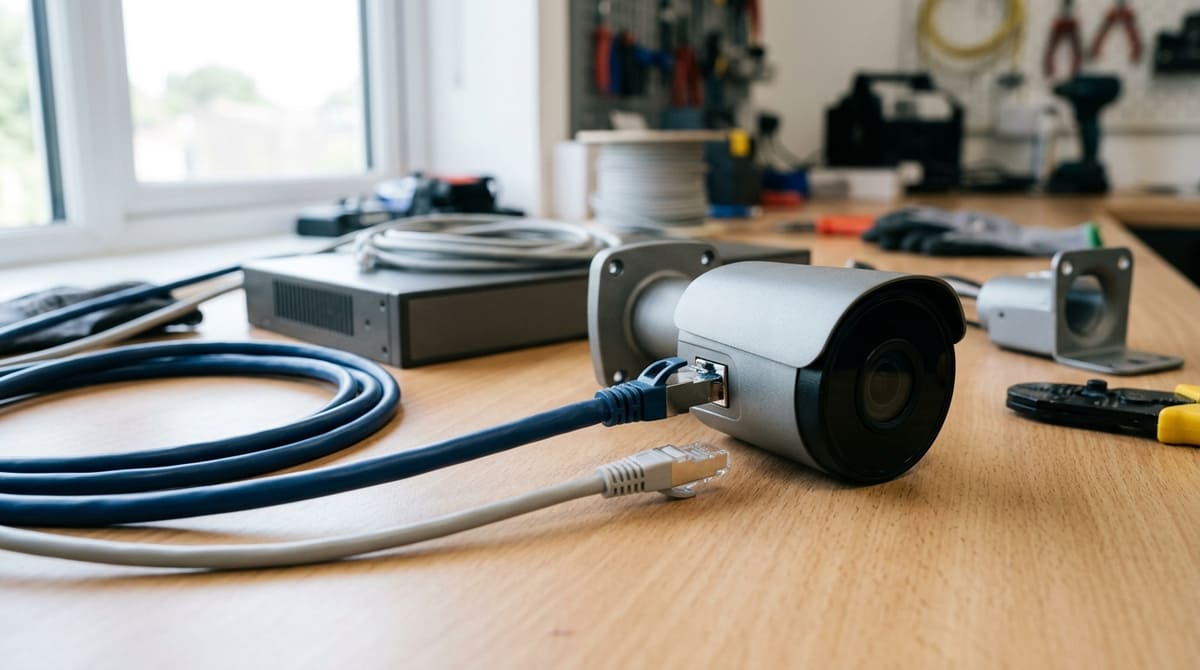
Cat5e is enough for a typical IP camera run at 1 Gbps up to 100 m, and most single-camera cable-to-switch links never need more. Cat6a earns its premium on 10G uplinks, electrically noisy routes and cabling that has to outlast the first camera refresh. Plain Cat5 (without the "e") is an older standard that should not be specified for new installs. For a full range of Cat5e cables and connectors, check the category landing.
What actually matters when choosing cat5 vs cat6a
Four criteria separate the two: the speed and distance you need, how much interference the route sees, whether the connectors and tooling suit the cable, and how long the cabling has to last. Everything else is secondary for a CCTV job.
1. Speed at full run length
Cat5e is rated for 1 Gbps at 100 MHz over 100 m, while Cat6a supports 10 Gbps at 500 MHz over the same 100 m, according to the Computer Cable Store comparison. Plain Cat6 only reaches 10 Gbps up to around 55 m. A single IP camera rarely needs more than 1 Gbps, so this matters most on NVR uplinks, switch-to-switch links and any run you expect to upgrade.
2. Interference and cable routing
Cat6a is built to reduce crosstalk where many cables sit close together. On outdoor or plant-room routes, shielding can matter as much as the category number. Our Connectix TruLAN Cat6A F/FTP outdoor cable uses foil-shielded pairs with a polyethylene sheath for external runs.
3. Connectors and termination
Cat5 and Cat6a connectors share the same 8P8C RJ45 format, so the plug format is not the barrier. The difference is fit and technique: Cat6a cable can be thicker, so check that the plug is rated for it. Use connectors and a crimp tool that are compatible with the cable you are terminating, and follow the manufacturer's termination guidance. Sockets follow the same logic: match the socket's rating to the cable.
4. Lifespan of the install
Cabling is the part you cannot easily swap once it is behind walls. If a run is being pulled once and will stay for years, Cat6a is the safer specification; for a short, like-for-like camera replacement on existing Cat5e, it is often not necessary. Cost depends on the length, shielding and jacket type, so open a trade account for live pricing.
Cat6A U/FTP Network Cable with RJ45 Connectors — best for 10GbE-ready IP camera runs
This pre-terminated Cat6A U/FTP patch cable suits installers who want a shielded, 10 Gigabit-capable link to a camera, NVR or switch without terminating on site. Its individually shielded pairs are the main step up from a plain Cat5e lead.
- Cat6A rating: built for Gigabit and 10 Gigabit Ethernet. Cat5e has no guaranteed 100 m 10GBASE-T rating, so Cat6A is the safer choice for a 10G switch port. Category-level figures are in the CNET specifier's comparison.
- U/FTP construction: each pair is individually shielded, which can help in bundles and near power cabling.
- LSFH jacket: low smoke, halogen-free sheathing for buildings where that is specified.
- Pre-terminated RJ45 ends: quick to install, with no on-site termination needed.
Trade-off: the length is fixed, so skip it for long or bespoke permanent runs. A reel of solid-core Cat6A terminated to a socket suits those better. Shielded cable can also be stiffer than Cat5e and needs sensible handling, so it may not route as easily in tight trunking.
Trade accounts see live pricing: Cat6A U/FTP Network Cable with RJ45 Connectors
Connectix TruLAN Cat6A F/FTP Outdoor Cable PE Sheath — best for external CCTV runs
Best for external and mixed indoor/outdoor CCTV runs where you want Cat6A headroom and foil-shielded pairs in a polyethylene-sheathed cable. This is the Cat6A answer to a Cat5 outdoor run: the cable is built for the environment, not just the bandwidth.
- Cat6A F/FTP construction: foil-shielded twisted pairs, which helps limit interference where cable sits near power or other services.
- Polyethylene (PE) sheath: made for external installations, so it suits routes that leave the building.
- Multi-use: the product data lists external installs, structured cabling and CCTV.
- Bandwidth headroom: Cat6A is generally quoted at 500 MHz and 10 Gbps over 100 m, against 100 MHz and 1 Gbps for Cat5e, per Computer Cable Store.
Trade-off: Most single IP cameras won't use 10 Gbps, so on a short, simple run with no interference concerns, Cat5e or Cat6 may be enough. Shielded cable also needs proper termination and earthing by your installer, so check the datasheet first. Cost depends on account pricing.
If you terminate in the field, use connectors and tooling that are rated for this cable's construction and shielding, and follow the datasheet.
Order the cable here: Connectix TruLAN Cat6A F/FTP Outdoor Cable PE Sheath
Cat6A 305m Solid Core Network Cable Grey — best for fixed structured cabling runs
Best for installers pulling permanent CCTV IP and commercial LAN runs, this 305m reel of solid core Cat6A supports Gigabit and 10 Gigabit networks, so it covers cameras today and higher-speed uplinks later.
- Cat6A on a 305m reel, which suits multi-camera or multi-drop jobs where you cut to length rather than buy pre-made leads.
- Solid core conductors, intended for structured cabling: fixed, in-wall or containment runs that are terminated once and left alone.
- Gigabit and 10 Gigabit support. Cat6A is generally rated to 500 MHz and 10 Gbps over 100 m, against 100 MHz and 1 Gbps for Cat5e, per the Computer Cable Store comparison.
- Terminates with a pass-through RJ45 crimp tool that covers CAT6A, CAT6, CAT5e and CAT5 connectors.
Trade-off: Solid core is not designed for repeated flexing, so skip it for patch leads or moving parts and use a pre-terminated lead instead. The product data does not say whether it is shielded, so check the datasheet if you need a screened cable. The cable also tends to be stiffer and larger than Cat5e, which can make tight containment harder work.
Order for your next job: Cat6A 305m Solid Core Network Cable Grey.
CAT6A S/FTP RJ45 Network Cable 3m - Orange — best for colour-coded shielded patching
Best for offices and server rooms that want a short, shielded Cat6A patch lead in a distinct colour, this 3m orange S/FTP cable lets you mark a specific circuit at a glance.
- Cat6A S/FTP construction: shielded cabling aimed at structured runs, where Cat6A is meant to cut interference in dense cable bundles.
- 10 Gbps headroom: Cat6A is rated for 10 Gbps over up to 100 metres, against 1 Gbps for Cat5e, per the Computer Cable Store comparison.
- Orange sheath: useful for separating a CCTV, uplink or other circuit from standard-coloured patching.
- Pre-terminated RJ45 ends: no crimping needed for a 3m lead, and the connectors are the same 8P8C form as Cat5e, so it fits existing ports.
Trade-off: at 3m this is a patch lead, not a run for pulling through walls. If your cameras only need 1 Gbps and the cable is unshielded, Cat5e will do the job; for long in-building runs, look at the reel or outdoor Cat6A lines instead. Shielding also relies on proper grounding through the patch panel and equipment.
Order it through your trade account: CAT6A S/FTP RJ45 Network Cable 3m - Orange
Which one should you buy?
For new CCTV and commercial cabling, buy Cat6a; keep Cat5e only for cheap short runs or existing cable you are not replacing. For new installations, avoid specifying old Cat5 at all.
- Budget: Cat5e suits a small PoE camera run where 1 Gbps is plenty. It is rated to 100 MHz and 100 m, per the Computer Cable Store comparison. Unlike Cat6a, it has no rating for 10 Gbps over a full 100 m link. Cost differences depend on account pricing, so ask for a trade quote rather than relying on a guide.
- Best overall: Cat6a is rated to 500 MHz and 10 Gbps over the full 100 m, according to the same source. That headroom matters when you are pulling cable once, through walls or conduit, and expect NVR uplinks, switches or extra cameras later. Our Cat6A 305m solid core reel is the permanent-run option.
- Outdoor or noisy routes: Choose a shielded Cat6a such as the Connectix TruLAN Cat6A F/FTP outdoor cable, which has a polyethylene sheath for external installs.
Check that your connectors and termination tooling are compatible with the cable you choose, including whether it is shielded or unshielded. Your own installer or electrician fits the kit, so follow the product datasheet. Trade buyers can open a trade account to see pricing.