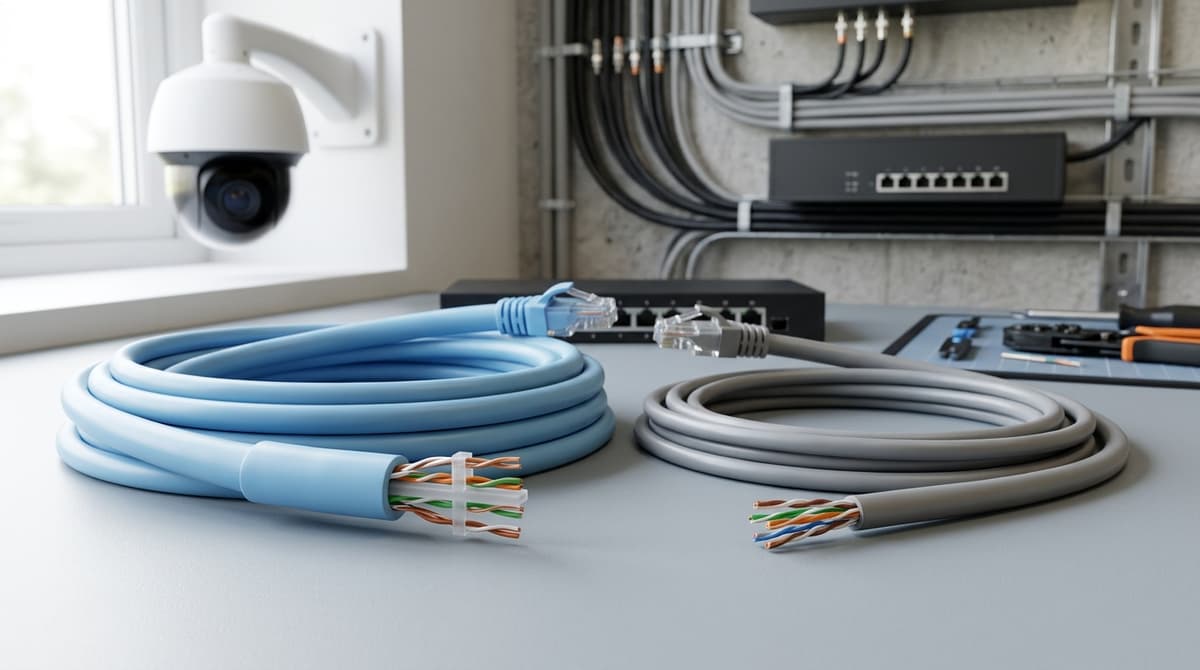
Cat6 costs more than Cat5e, but for CCTV work the decision comes down to how the cable behaves under sustained PoE current over your actual run length, not headline speed. Cat6 is commonly made with 23 AWG conductors and often a central spline, against the 24 AWG typical of Cat5e, which gives it lower resistance and better crosstalk separation — and that matters most once you're pushing power to cameras beyond 30 m or stacking multiple PoE devices on one switch. If your runs are short and your camera count modest, that extra spec often buys you very little; on longer or higher-load jobs, it's the few pounds per metre that stops you re-pulling cable later.
What actually matters when choosing Cat6 cable vs Cat5
For CCTV runs, four things decide it: bandwidth headroom for multi-camera NVR traffic, PoE budget under load, run length against 4K bitrates, and whether you're buying new or extending an existing Cat5 system. Everything else — colour, jacket branding, connector plating — is secondary to these.
1. Bandwidth headroom, not just top speed
Cat5e is specified to 100 MHz and supports Gigabit Ethernet. Cat6 is built to a stricter category standard at 250 MHz, supports 5GBASE-T over the full 100-metre run, and can carry 10 Gigabit over shorter distances — roughly 37 to 55 metres depending on crosstalk conditions, as trueCABLE's comparison sets out. For a single 4K IP camera this rarely bites. On a backbone run carrying 16 or 32 camera streams back to an NVR switch, that extra headroom is what stops you re-cabling in three years. If the run is a switch-to-NVR trunk rather than a single camera drop, buy the Cat6 headroom now.
2. PoE load and cable bundling
Both categories support PoE and cable calculator, PoE+ and PoE++ up to 100 W under the 802.3af/at/bt standards. Where Cat6 is made with the heavier 23 AWG conductor, it handles heat build-up better than 24 AWG Cat5e in large bundles at 30 W and above. On a rack with a dozen PTZ cameras drawing PoE+ down tightly bundled containment, that thinner Cat5e core runs hotter — a real factor if you're trunking many high-draw cameras through one riser.
3. Run length and future 10G uplinks
Both categories are specified to a maximum of 100 metres for standard Ethernet applications. If a job needs 10GBASE-T for an NVR uplink or a multi-camera aggregation switch, Cat6 gets you there only over shorter runs. For a genuine 10G target over the full 100-metre distance, that's a Cat6A conversation, not Cat6 versus Cat5. For typical CCTV camera drops under 90 metres at Gigabit speeds, either category will run the link reliably.
4. New build vs extending what's already there
Can you use a Cat6 cable instead of a Cat5? Yes — Cat6 is backward-compatible and will work in a Cat5 or Cat5e jack and patch panel, since all three share the same RJ45 termination and T568A/B wiring standard. That makes Cat6 the safer default on any new install or extension, since it costs little extra to future-proof a fresh run. For stocked patch leads, the 5m Cat6 RJ45 Ethernet Cable and the Outdoor Cat6 Ethernet Cable 3m cover short camera-to-switch drops without opening a full reel.
5m Cat6 RJ45 Ethernet Cable – High-Speed Network Patch Lead — best for short PoE camera or NVR runs
A 5-metre Cat6 patch lead with pre-fitted RJ45 connectors, built for exactly the run length most single-camera or desktop-to-switch jobs actually need. If you're wiring a camera to a nearby PoE switch, patching a router to a wall port, or linking an NVR to a network cabinet, this is the practical length to keep on the van rather than cutting down a longer reel.
- Cat6 spec gives more headroom than Cat5e for higher-throughput runs and copes better with denser PoE bundles thanks to its sturdier construction
- RJ45 connectors terminated ready to plug in — no crimping needed on install day
- Durable construction suited to trade use: patching cabinets, first-fix tidy-ups, camera-to-switch drops
- 5 m length suits short, fixed runs; for longer camera backhauls the 15m or 30m Cat6 leads avoid unnecessary joins
Not the cable to reach for outdoors or buried — it's an indoor patch lead, so external camera drops need a proper outdoor-rated Cat6 run instead. Account pricing applies once you're logged in.
5m Cat6 RJ45 Ethernet Cable – High-Speed Network Patch Lead
Cat6 Ethernet Cable 15m White RJ45 Snagless — best for longer camera-to-switch or NVR runs where Cat5 falls short on bandwidth
A 15 m Cat6 patch lead rated by its manufacturer to 650 MHz, with gold-plated RJ45 connectors and a snagless white jacket — this is the run installers reach for when a camera, access point or office desk sits further from the switch than a standard 5 m lead can comfortably reach. Compared with Cat5/Cat5e, Cat6's tighter twist and stricter manufacturing tolerance give it a real headroom advantage, particularly on longer runs carrying PoE cameras alongside data.
- 650 MHz manufacturer rating — well above the 250 MHz the Cat6 standard requires, giving more margin against crosstalk as run length increases
- Gold-plated RJ45 connectors for a more reliable, corrosion-resistant contact than budget cables — worth it on cable runs you don't want to re-terminate later
- 15 m length covers longer indoor runs (reception desks, back offices, camera drops to a wall-mounted switch) without needing a coupler, which is where signal loss starts creeping in on cheaper cable
- Snagless white boot — practical for visible office and reception runs where a black cable stands out, and reduces clip damage during pulls through trunking
If you're only running short desk-to-switch jumps, a 5m Cat6 RJ45 Ethernet Cable is the more sensible buy — no point paying for 15 m of slack. For outdoor camera runs, this indoor-rated lead isn't the one; check the dedicated Outdoor Cat6 Ethernet Cable instead. Account pricing and stock depth are on the product page — open a trade account at Euro CCTV or buy direct: Cat6 Ethernet Cable 15m White RJ45 Snagless.
Outdoor Cat6 Ethernet Cable - 3m RJ45 Patch Lead — best for camera runs that step outside
A weatherised 3 m Cat6 patch lead built for the point where an internal Cat6 run has to cross a wall or soffit and face the weather, rather than for a like-for-like Cat5 vs Cat6 comparison on a desk. If you're already choosing Cat6 over Cat5 or Cat5e for a camera or AP drop, this is the length that typically bridges the gap between an internal cable run and an external housing or PoE injector.
- 250 MHz U/UTP construction — the Cat6 specification, against Cat5e's 100 MHz — giving Cat6's usual crosstalk headroom in a run that's exposed to the elements.
- PVC outer jacket rated for outdoor use, so it tolerates the UV and damp exposure that an indoor-only Cat5 or Cat5e lead isn't built for.
- Gold-plated RJ45 connectors resist corrosion at the joint — the usual failure point on an outdoor cable long before the copper conductors give out.
- 10-year warranty, useful reassurance on a cable that's going to sit outdoors, out of easy reach, for the long haul.
The trade-off: at 3 m this is a short jump lead, not a structured cabling run — for longer outdoor distances look at reeled Cat6 or a proper external-rated bulk cable instead. It's also U/UTP rather than shielded, so if the route runs near heavy electrical interference, a shielded cable is the better call.
Outdoor Cat6 Ethernet Cable - 3m RJ45 Patch Lead
Cat6 RJ45 Ethernet Cable 30m – Blue U/UTP Patch Lead — best for long PoE camera runs where headroom matters
This is a 30 m Cat6 U/UTP patch lead with gold-plated RJ45 connectors and 250 MHz bandwidth — the right choice when you're running a camera, NVR or switch further than a standard patch lead reaches and want Cat6's extra headroom over Cat5e rather than cutting a long run from a box.
- 250 MHz bandwidth — the Cat6 specification, well above Cat5e's 100 MHz, giving more crosstalk margin over a long single run.
- 30 m length — long enough to reach a camera at the far end of a warehouse or car park without a mid-run joint, which is where signal loss and water ingress usually start on a CCTV job.
- Gold-plated RJ45 connectors — resist corrosion at the contact points, useful anywhere the cable runs through a loft, riser or plant room with damp or temperature swings.
- U/UTP (unshielded) — fine for typical indoor and light commercial runs, but if the cable will sit near mains cabling, motors, or other high-EMI sources, a shielded (F/UTP) run is the safer call.
Trade-off: this is a fixed 30 m length, so if you only need a few metres to a desk or a single camera drop, our 5m Cat6 RJ45 Ethernet Cable is the tidier option — don't buy 30 m and coil the excess behind a switch. Account pricing applies once you're logged in; your own electrician or installer should handle the actual termination and fitting.
Cat6 RJ45 Ethernet Cable 30m – Blue U/UTP Patch Lead
Which one should you buy?
For a straightforward CCTV run under 100 metres with a handful of PoE cameras and no plans to upgrade in the next few years, Cat6 is the sensible default rather than a luxury. Its 5GBASE-T support at 100 metres, its typically heavier conductors and its better tolerance of higher PoE loads in bundled runs give it more headroom than Cat5e without a significant cost jump on short patch leads.
Budget or one-off patch lead: if you're finishing off a rack or connecting a single camera to a switch over a short distance, a basic run does the job and cost is the deciding factor rather than bandwidth headroom. A 5m Cat6 RJ45 Ethernet Cable covers this without overspending on capability you won't use on a five-metre hop.
Best overall for new CCTV installs: for anything going into walls, ceiling voids or external runs that you don't want to redo in three years, Cat6 is the safer spec across the board. Outdoor runs specifically warrant a cable rated for the environment rather than a standard patch lead — the Outdoor Cat6 Ethernet Cable with its 250 MHz bandwidth and 10-year warranty fits that brief.
Larger sites or multi-camera runs: for longer indoor pulls connecting distribution cabinets to camera clusters, length matters as much as category. The Cat6 RJ45 Ethernet Cable 30m or the 15m white snagless option suit office or plant-room installs where Cat6's stricter TIA-defined performance requirements over Cat5e earn their keep. If you're outfitting multiple sites regularly, opening a trade account gives you account-specific pricing.
This article was researched and written by itmaster.uk.