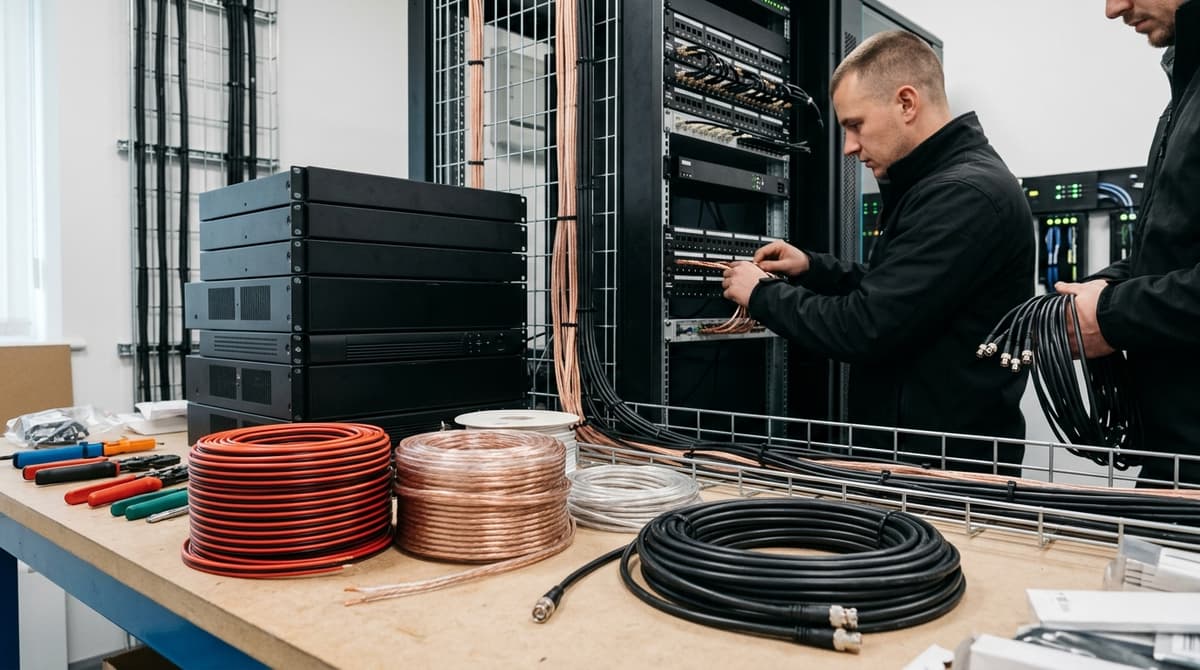
Speaker wire cable is not the same job as CCTV video or data cable: it carries an analogue audio signal to a siren, horn or two-way talk speaker, so gauge, weatherproofing and impedance matching matter more than category ratings. Get those three things wrong and you get a quiet, distorted, or dead speaker — not a system that just runs slower. For UK installers running a figure-8 speaker line alongside PoE and coax on the same job, the fix is straightforward once you know what actually drives audio quality over distance: copper gauge, not category rating.
Speaker Wire Cable for CCTV & Audio-Enabled Security Systems: UK Buyer's Guide 2026
Speaker wire cable for CCTV audio is sized by conductor gauge for impedance and run length, not category-rated like network cable. Unlike a network or mains cable, it carries a low-voltage analogue signal where conductor cross-section and insulation matter more than any data standard.
Gauge and impedance. Two-way audio speakers and horn sirens on CCTV systems are usually 8-ohm devices driven over short runs, so a figure-8 cable with fine stranded conductors is normal practice. Our own stock includes a 2 × 32/0.2 mm pure copper figure-8 speaker cable sold on 100 m reels for exactly this kind of run. Longer external runs need a heavier gauge to keep resistance — and volume loss — down; thinner "regular" bell wire isn't equivalent, which is the practical answer to whether speaker wire differs from ordinary wire.
Weatherproofing and routing alongside PoE runs. Externally mounted horns and talk-down speakers need an outdoor-rated jacket, sealed glands at entry points, and cable clips or containment kept separate from PoE camera runs to avoid induced hum on the audio line. Where a camera itself carries two-way audio, such as the Hikvision DS-2CE78K0T-LTS turret, its integrated microphone and speaker pass audio over the coax feed to a compatible Hikvision DVR, avoiding a separate speaker run entirely.
Termination. Bare-wire, spade, and screw-terminal ends dominate CCTV audio wiring; banana plugs and adapters are more of a domestic hi-fi fitting. For extending a run, use a proper in-line connector rather than twisting joints, and confirm gauge before ordering — open a trade account for stock and reel-length options.
Why does a CCTV audio deterrent or two-way talk system need its own cable?
A CCTV audio deterrent or two-way talk system needs a dedicated speaker wire cable because its output is a low-impedance analogue audio signal, not a data stream, and coax or Cat6 already on site is built for a completely different job. Treating the audio run as an afterthought — tapping a spare Cat6 core or a thin alarm-grade wire — is a common cause of a speaker that sounds faint, distorted, or doesn't work at all.
Two different jobs, two different cables
Video and network cable moves data; audio deterrent cable moves current, and conductor gauge matters more than any category rating. Cat6 conductors are sized and twisted to control signal timing and crosstalk for Ethernet, not to carry the sustained current a horn speaker or amplified siren draws. A speaker circuit needs enough copper cross-section to keep resistance low over distance, otherwise volume and clarity drop off well before the cable "fails" outright.
Some cameras sidestep this problem entirely by carrying audio over the same coax as the video feed. The Hikvision DS-2CE78K0T-LTS is one example: it has an integrated microphone and speaker, and supports two-way audio over coaxial cable when connected to a compatible Hikvision DVR that supports audio over coax. For that specific path, no separate speaker run is needed — the existing coax carries both signals.
Where a dedicated run is unavoidable
Where the system instead drives an external horn speaker, an amplified siren, or a PA-style output from an NVR or standalone audio module, that output is a proper low-impedance speaker line. It needs conductor sized for the run length and the current involved, not a repurposed data cable. This is the same reasoning that applies to any speaker wire choice in a domestic hi-fi context — gauge and run length matter more than brand — but on a CCTV deterrent circuit the consequence of getting it wrong is a warning message nobody can hear rather than muddy bass.
- Coax with built-in audio — cameras like the DS-2CE78K0T-LTS, no extra cable needed for that path.
- External horn/siren from an NVR audio output — needs a dedicated speaker-rated run, sized to the manufacturer's distance and impedance guidance.
- Repurposed Cat6 or thin alarm cable — commonly tried, but not built for sustained audio current; avoid it where a proper run is practical.
For dedicated audio circuits, our Wire & Cable stock includes figure-8 speaker cable with 32/0.2 mm pure copper conductors, which gives installers a purpose-built option rather than adapting whatever's left on the reel.
Is there a real difference between speaker wire and "regular" wire?
Yes — speaker wire is stranded copper sized for continuous audio current at low impedance, and swapping in bell wire or thin data-cable cores will cost you volume and clarity over any real distance. It's a question that comes up constantly on audio forums, and the answer sits in the construction, not the marketing.
Speaker wire is normally two conductors (or four for bi-wire runs), stranded rather than solid-core, in oxygen-free or standard copper, sized to match the run length and the current the amplifier is driving — the Wikipedia overview of speaker wire covers the basic construction well. The figure-8 cable in our Wire & Cable range is exactly this construction: two 32/0.2 mm stranded pure-copper conductors, colour-coded for polarity, on a 100 m reel.
What gauge (AWG) of speaker cable should you run for a siren, horn or two-way audio point?
Match the gauge to the run length and the speaker's power draw — a thinner core than the run needs is the single biggest cause of a weak, quiet CCTV siren. Voltage drop scales with both cable resistance and distance, so a 30-metre external run to a horn speaker needs a heavier gauge than a 3-metre internal run to a two-way audio module on the same wall as the NVR. Choosing purely from whatever reel happens to be on the van is how installers end up back on site re-pulling cable.
| Run length |
Typical AWG |
Notes |
| Under 10 m |
16 AWG |
Fine for most low-power CCTV horn speakers and two-way talk modules |
| 10–20 m |
14 AWG |
Recommended once you're past a short internal run |
| 20 m+ |
12 AWG |
Needed for longer external runs or higher-power PA/siren outputs |
This is the general trade guidance for 8-ohm loads; actual current draw varies by amplifier and horn model, so check the manufacturer's rated impedance and power figures before committing to a gauge on a long run.
Why this matters more on audio-over-coax setups
Some analogue turret cameras carry two-way audio over the same coax as video — the Hikvision DS-2CE78K0T-LTS, for example, has an integrated microphone and speaker that support two-way audio when connected to a compatible Hikvision DVR over coax. On these systems the "speaker cable" question doesn't apply in the traditional sense, since audio rides the coaxial run rather than a dedicated pair. Gauge selection matters specifically for standalone horn speakers, sirens and PA modules fed by separate wire.
Practical sizing notes
- Don't mix gauges mid-run. A short 16 AWG jumper spliced onto a long 12 AWG pull reintroduces the same voltage drop the heavier cable was chosen to avoid.
- External runs lose more to resistance over temperature swings, so if a 20 m-plus run is exposed to weather, sizing up rather than sizing to the exact calculated minimum gives some headroom.
- Higher-power sirens and PA horns draw more current than a typical low-power CCTV horn speaker, which pushes the required gauge up even on a moderate run length.
- Secure the run properly with cable clips rather than leaving slack coiled near a horn's terminals — loose cable is more likely to be pulled, flexed or nicked during later maintenance.
For UK trade buyers stocking multiple gauges for site work, a trade account lets you hold 16, 14 and 12 AWG reels against different job types rather than guessing on a single generic reel for every run.
How do you wire and terminate speaker cable on a security install without introducing noise or a weak connection?
Correct polarity and a solid mechanical termination matter far more on a security audio circuit than exotic cable — get positive and negative right at both ends and use a connector rated for the environment it sits in.
Polarity first. The positive conductor is identified consistently across a reel — a coloured stripe, a printed "+", or on cheaper twin-core reels a ribbed section of jacket on one side only. Trace that marking from the amplifier or NVR audio output all the way to the speaker terminal and keep it consistent on every run. On a multi-speaker deterrent or PA setup, one reversed pair causes phase cancellation between speakers and leaves the announcement or warning tone sounding thin and weak rather than clear.
Choosing the end type
Speaker wire end types depend entirely on what the equipment accepts, so check the terminal block on the audio module, siren driver or amplifier before you crimp anything.
- Bare tinned ends — fine for screw-clamp terminals on horn speakers, sirens and many NVR audio-out blocks; strip cleanly and twist the strands so no stray copper can bridge to the adjacent terminal.
- Spade or ring terminals — a more secure, vibration-resistant connection on amplifier binding posts, useful where cable runs through plant rooms or external cabinets subject to movement.
- Banana plugs — quick to swap and test, but only where the equipment has banana sockets; rare on dedicated security audio hardware.
For screened or armoured runs feeding external speakers, a proper speaker wire connector rated for the enclosure — rather than an improvised twist-and-tape joint — keeps moisture and vibration from working a bare joint loose over time.
Adapters and extensions
A speaker wire adapter or inline extension joint is sometimes unavoidable on a long external run, but every extra joint is a point where polarity can get swapped or a connection can loosen. Where an extension is needed, terminate both ends properly rather than twisting bare conductors together, and keep the joint inside a junction box rather than exposed.
Fixing and routing
Cable clips and cable management channel keep runs dressed along joists, trunking or wall voids, reducing strain on terminations and stopping the cable being pinched by fixings — a crushed or nicked conductor is a common source of intermittent noise, not the cable spec itself. The Power Speaker Cable Figure-8 Red/Black comes on a 100-metre reel of 2-core 32/0.2 mm pure copper, giving enough length to plan clip spacing and terminations for a full run without mid-run joins on most single-zone deterrent or PA installs.