
cctv for dark winter evenings uk
CCTV for Dark Winter Evenings UK: Dusk-to-Dark Camera Check
Most modern CCTV cameras still record after dark, but one set up in summer can quietly fail at 5pm in November, when the light drops before you're home to…
On this page
- How do I check my CCTV after the clocks go back?
- Walk order
- The pass test
- Is the IR or white-light switchover happening at dusk, and is the exposure right?
- Day/night switching
- Reflected IR
- Colour night modes
- Exposure for cars on a driveway
- What should I clean and inspect on the lens and housing?
- Do my motion zones and alerts still make sense with longer shadows?
- Recalibration sequence
- AI person and vehicle detection
- Privacy masks
- Is the NVR clock, DST setting and recording still correct?
- Timekeeping
- Recording checks
- Storage maths
Most modern CCTV cameras still record after dark, but one set up in summer can quietly fail at 5pm in November, when the light drops before you're home to notice. The fix is a dusk-to-dark audit of each camera. Start about an hour before dark so you see the day-to-night switch happen, and carry on until it is fully dark. The total time depends on when darkness falls where you are.
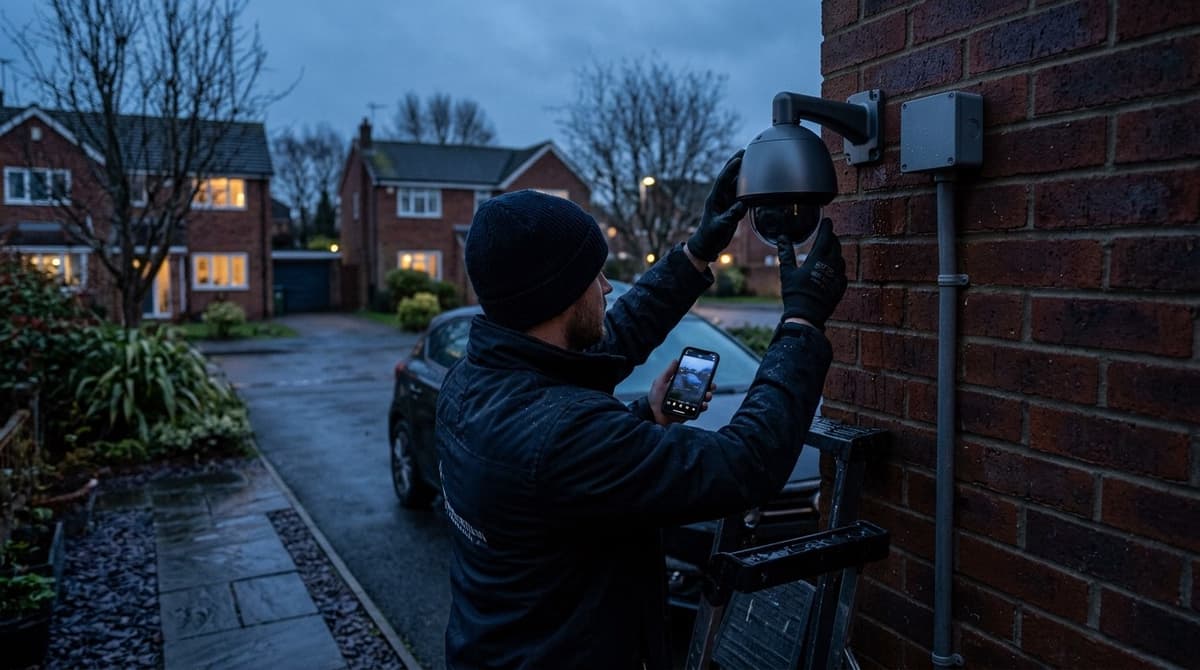
Also check that your recorder's clock and recording schedule survived the clocks going back on 25 October. Compare the recorder's time-zone and daylight-saving settings against its manual, then confirm the timestamp on screen matches the real time. This covers existing driveway and porch systems you can check from the ground and in the app, so leave anything that needs a ladder, such as re-aiming or cleaning a high camera, to an independent NSI or SSAIB-inspected installer.
How do I check my CCTV after the clocks go back?
Check at dusk rather than midday, starting about an hour before dark and carrying on until full dark, so you see the day-to-night switch happen. The clocks went back on Sunday 25 October 2026, so the evening hours your cameras cover are now dark far earlier. CCTV needs enough light to be effective 24 hours a day, so a camera that coped in September may not cope now.
Walk order
- Driveway camera. Start here, since it usually covers the vehicle and the approach.
- Porch or door camera. Check it next, as it has to deal with the glare of porch lights.
- Side-gate coverage. Finish here, where light is typically weakest.
At each camera, open live view in the app, then on the NVR monitor, then review last night's recorded clip. The three can look different, and the recording is what you would hand to the police. Also check that the recorder's displayed timestamp matches the real time, because time-zone and daylight-saving settings vary by model and should be set as the manual describes.
The pass test
- Can you tell a person from a bush?
- Can you read a number plate on a car in its usual parking spot?
Moving shapes are not identification. Judge it from your own recorded night footage: if you could not confidently pick out a face or read a plate from last night's clip, the camera or the lighting needs work. To decide whether to adjust the lighting or change the camera, our IP, analogue and wireless camera comparison will help.
Is the IR or white-light switchover happening at dusk, and is the exposure right?
Yes, if the camera switches mode once as light falls, stays there, and its exposure suits moving cars rather than a still scene. Check this at dusk on site, not at midday.
Day/night switching
As general installer guidance, the camera should change to night mode once and hold it. If it flickers between modes under a porch light or streetlamp, the sensor is reading that lamp as changing daylight. Re-aim so the lamp is out of frame, or adjust the switch sensitivity and delay if the camera offers them.
Reflected IR
A close wall, soffit, porch ceiling, spider web or raindrop bounces the camera's own infrared back at the lens and washes out the picture. Re-aim away from the surface, or re-site the camera on a bracket that clears it. Otherwise turn IR off and rely on a lit scene.
Colour night modes
"Colour night vision" and white-light modes still need some light to produce colour. They typically use a lamp on the camera or existing lighting, and without either they fall back to monochrome. To judge whether faces are identifiable, review your own recorded night footage at the spot where someone would actually stand, rather than trusting the live view or the lux figure on the box.
Exposure for cars on a driveway
A slower shutter brightens the picture but blurs plates on moving vehicles. A faster shutter freezes them but needs more light, so fix the lighting before pushing the shutter. Gain lifts a dark image but adds noise.
Enable WDR to stop headlights blowing out the scene. Then drive a car through at dusk and read the recorded plate, not the live view.
What should I clean and inspect on the lens and housing?
Check six things: webs or nests on the lens and IR window, fogging inside the dome, loose brackets, gaps at the cable glands, and vegetation growing into the view.
- Lens and IR window: Spiders and insects are commonly drawn to the warm housing, and a web close to the lens bounces IR light back as glare that washes out the night image.
- Inside the dome: Look for misting, droplets or a tide line on the inner surface.
- Brackets: Any movement in the arm or wall plate will shift the field of view, so check the fixings after wind.
- Cable glands: Look for gaps, perished rubber or a cable pulled out of line.
- Vegetation: Winter growth that sways in front of the lens can trigger motion alerts all evening.
Condensation matters because it means moisture is inside a housing that should be sealed. It blurs the image, scatters IR, and can corrode the board over time. Fogging that clears by midday and returns each evening usually points to a failed seal or a gland letting damp air in.
On the datasheet, the IP code follows IEC 60529 (BS EN 60529). The first digit covers solids and dust, and the second covers water. Higher digits mean more protection, but the rating applies only when the housing is intact and correctly sealed.
Wiping visible dirt, clearing webs and trimming back plants is a homeowner job. Opening a sealed housing, re-terminating cable or working at height should go to an independent accredited installer (NSI or SSAIB).
Replacement brackets, glands and sealing parts are covered in our CCTV accessories wholesale guide. If a camera is beyond saving, Dahua cameras are available to trade accounts, with stock and back-order status shown live on each product page.
Do my motion zones and alerts still make sense with longer shadows?
Probably not: zones drawn in summer often catch winter shadows and headlight sweeps, so redraw them tight to the drive and porch threshold.
Low winter sun throws long shadows from trees, fences and parked cars across the frame. As the sun moves, those shadows can trip a zone, or a person walking through a shadowed patch can blend into it and go unflagged. After dark, headlights sweeping across a drive set off alerts that a daytime setup never saw.
Recalibration sequence
- Re-draw each zone to cover only the drive and the porch threshold.
- Pull the zone edges back from trees, the road and neighbours' property.
- Re-test at night. Have someone walk in from the gate to the door, then drive a car past on the road. You should get an alert for the first and none for the second.
AI person and vehicle detection
If your camera has AI person/vehicle detection, switch it on. It can cut alerts from rain and insects because the camera only flags shapes it recognises. It is camera-dependent, so check the datasheet for the model you own, as plain pixel-change motion detection cannot tell a person from a moth.
Privacy masks
If a re-aim now catches a neighbour's window or the public road, blank that area with a privacy mask and review the framing against the ICO's CCTV guidance. Our guide to UK CCTV Law 2026: What Owners Must Know covers what applies to your setup.
Is the NVR clock, DST setting and recording still correct?
Check three things now: a London time zone with the right DST behaviour, a working NTP sync, and genuine overnight recording on every channel.
Timekeeping
Set the time zone to London (GMT in winter, BST in summer), then check the recorder's manual to see how it handles daylight saving. Some units change themselves when a London zone is selected with DST enabled. Others sit on a fixed offset and need adjusting by hand when the clocks move. Whichever applies, confirm the displayed timestamp after every clock change.
Turn on NTP sync and confirm the NVR can reach its time server. Then hold a phone clock next to the on-screen overlay. If the cameras stamp their own overlay as well as the NVR, check both.
An hour's offset matters because every other record is timed against a real clock: the police request, the insurer's incident time, the phone alert, the neighbour's doorbell clip. Searching by time window then returns the wrong hour, and footage of CCTV in the dark is hard enough to read without doubts about when it was taken. Exporting clips is where a bad timestamp hurts most, and our Bonfire Night CCTV footage evidence tips cover that side.
Recording checks
- Confirm the schedule template covers all 24 hours, not a daytime-only pattern, and that the recording mode (continuous or event-based) is the one you intended.
- Play back last night's clip from every channel on the NVR, then again through the phone app.
- Send a test alert to the phone and check the notification's time against your own clock.
Storage maths
Retention days = usable disk capacity ÷ (combined camera bitrates × 86,400 ÷ 8). Keep the units consistent: the 86,400 turns bits per second into bits per day, and the ÷8 converts bits to bytes. Use the capacity the NVR reports as usable, not the figure on the drive label.
Night-time noise often pushes bitrates up, because the encoder spends bits on grain. Retention that looked comfortable in summer can therefore shrink over winter, so re-run the sum with current bitrates.
If the disk is failing or already full, the usual fix is a surveillance-rated replacement, and Seagate and Toshiba both make them. Installers can open a trade account with Euro CCTV to order those drives, with in-stock items ordered before 4pm Monday to Friday dispatched the same working day.
Frequently asked questions
Can cctv cameras see in the dark?
Most cameras still record in the dark, but a camera set up in summer can fail at 5pm in November. Judge it by the footage, not the spec sheet. You should be able to tell a person from a bush, and a moving shape is not identification.
How to make cctv better at night?
Run a dusk-to-dark audit. Start about an hour before dark and watch each camera switch from day to night. ProtectUK's security lighting guidance says CCTV needs sufficient light to be effective 24 hours a day, so check lighting, lenses and motion zones too.
What is the best cctv for night vision?
No single model wins for every property, and this research doesn't support naming one. Choose by your own pass test. At night, can the driveway camera read a number plate in the usual parking spot, and can the porch camera clearly show a face or figure?
What should I check on the recorder after the clocks go back?
Check that the NVR clock and recording schedule survived the change on 25 October. Then review last night's recorded clip from each camera. The footage should exist, and its timestamp should match the real time.
When should I call an installer?
Call one for ladder work, or if a camera still fails the night test after you've checked the basics. Use an independent NSI or SSAIB installer rather than attempting high-level adjustments yourself.
Sources & references
- Night Vision Security Cameras for New Zealand's Darker Months - All Round Security
- Security lighting | ProtectUK
- Night Vision CCTV: UK Guide for Dark Nights 2026 | Netview - Netviewcctv.co.uk Hikvision Updates News & Downloads
- Darker Nights, Greater Risk: Is Your CCTV System Winter ...
- Security Lighting and CCTV: Light Your Cameras Properly | Doberman
- cctv
- dark
- winter
- evenings
- uk
Written by
Euro CCTV Editorial Team
The Euro CCTV team's guides are researched against the products we stock and the manufacturers' own datasheets, and fact-checked before they publish.
Related reading
- Bonfire Night CCTV Footage: Evidence Tips for 2026bonfire night cctv footage
- Access Control Suppliers UK 2026access control supplier uk
- CCTV Accessories Wholesale: Van Stock 2026cctv accessories wholesale
- Dahua Distributor UK 2026: Spot Genuine Stockdahua distributor uk
- CCTV Parts Wholesaler in London — Brent Cross Trade Countercctv parts wholesaler london
- UK CCTV Law 2026: What Owners Must Knowcctv cameras uk law