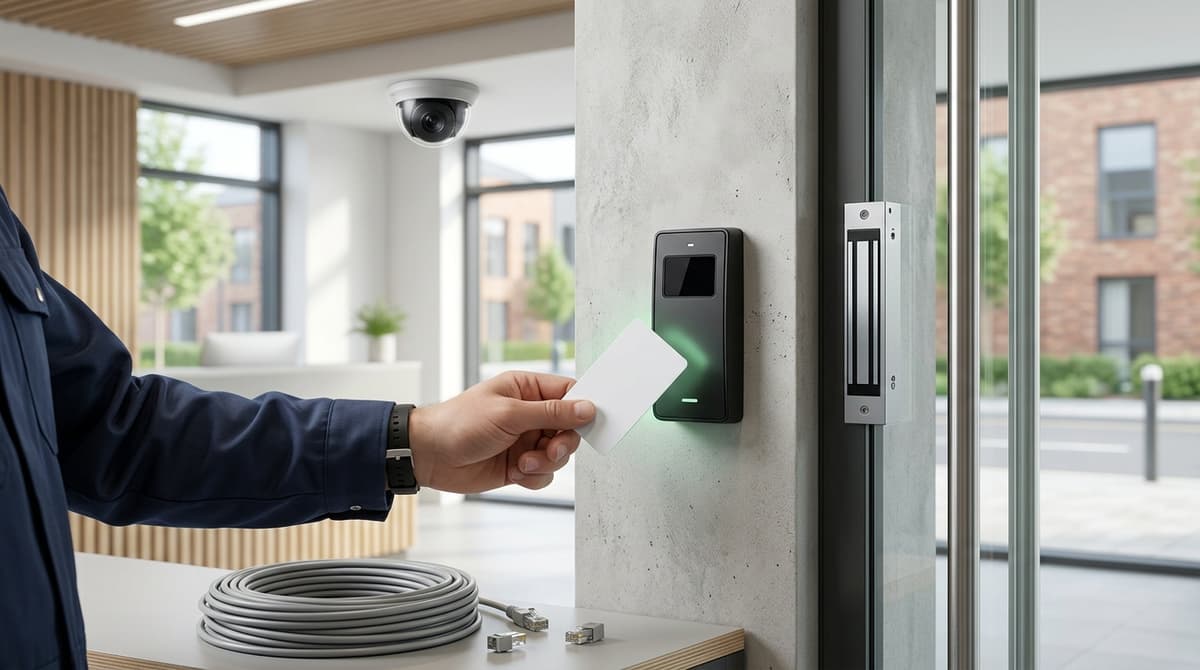
Most UK trade orders in 2026 aren't a single access control box — they're a compatible stack of readers, controllers and expansion modules chosen to survive integration onto the same network as the CCTV. Buyers who spec each layer separately, then confirm each device's actual interface before ordering, are the ones who avoid a return trip to site.
This piece breaks down what's actually in the trade basket. Stock status now decides delivery dates as much as the datasheet does.
OUR OWN PRODUCTS (LINK THESE where relevant; do not invent other products)
For standalone door control, our ACM-A60W-EM RFID Access Control Keypad handles PIN codes or RFID cards and wires into external controllers, electric locks, exit buttons and door sensors. The 125KHz ID Card Access Control Keypad supports up to 1,000 users and ships with five keychains, so it suits sites that need proximity cards rather than PIN-only entry.
The metal-bodied ACM-208C-ID keypad is built for the same job — managing users via stored PINs or RFID cards — and is aimed at small to medium installations rather than large multi-door sites. Check the specific interface options with us before specifying it against an existing controller, as we don't have a confirmed product page for that exact model live yet.
Where a site needs to bring more doors onto one controller, the Hikvision DS-K2M002X 2-Door Access Control Expansion Module adds two extra doors to a compatible controller over an RS-485 interface, including RS-485 card reader connections. It's priced as a mid-range accessory rather than a full controller, so budget for it alongside the main panel, not instead of one.
All of these are supply-only lines — we sell the hardware at trade prices with next-day UK delivery, but wiring, commissioning and configuration are down to your install team. Open a trade account at eurocctv.co.uk to see live pricing and stock for each SKU.
Frequently Asked Questions
What is a MAC address used for on IP access control kit?
A MAC address is a fixed hardware identifier assigned to a network interface — it's how a switch or NVR recognises a specific IP camera, IP door controller, or IP reader on the network. For IP-connected access control devices it's usually fixed per unit and is commonly used for identification and MAC whitelisting on managed switches. It doesn't apply to RS-485 expansion modules or non-networked keypads, since those devices have no Ethernet interface of their own.
Do standalone keypads like the ACM-A60W-EM connect straight into an IP network?
No — the ACM-A60W-EM is a standalone RFID access control keypad designed to integrate with external access control systems, controllers or security management platforms, controlling electric door locks, magnetic locks, exit buttons and door sensors. It isn't an IP device in its own right, so check with the manufacturer or your controller's documentation for the exact wiring and signalling it supports before specifying it into a networked setup.
Does the DS-K2M002X have its own IP address or web interface?
No. The Hikvision DS-K2M002X is a 2-door access control expansion module that connects to an access controller via an RS-485 interface, and it supports card reader connection over RS-485 too — it isn't a standalone networked device with its own configuration page. Treat it as an extension of your main controller rather than a separate network endpoint.
Can access control share the same network as CCTV?
Increasingly, yes — access control and CCTV are often run over the same IP network infrastructure and brought together at the software or platform level rather than through direct device-to-device links. That's a practical wiring and cabling decision more than a strict interoperability standard, so plan your PoE budget and switch capacity with both systems in mind from the outset.
Access Control Suppliers UK: What the Trade Is Actually Buying in 2026
Networked access control that shares infrastructure with the VMS is what most installers are specifying in 2026, not isolated standalone keypads. A door controller increasingly needs to sit on the same IP backbone as CCTV, rather than run as a separate silo with its own wiring and its own software. The shift is being driven by mobile credentials, cloud-managed platforms, and door hardware built to integrate with the wider security network rather than operate in isolation.
This changes what "access control entry" means on a job sheet. Rather than a single keypad logging a PIN locally, an access control entry now typically needs to write to a shared event log alongside video, so a supervisor can pull up the door swipe and the matching camera clip from one interface.
Standalone units haven't disappeared. A 125KHz proximity keypad supporting 1,000 users, such as the Door Access Control System 125KHz, still covers plenty of single-door jobs on a fixed budget. The growth, though, is in networked expansion modules and controllers designed to integrate rather than sit alone.
Role-based access control is part of the same trend. Rather than every card holder getting identical rights, installers are asking for platforms where access control role based permissions can be set by job title or shift pattern, and changed centrally rather than reprogrammed door by door.
A two-door expansion module like the Hikvision DS-K2M002X, which connects to an access controller over an RS-485 interface and supports card reader connection per door via RS-485, is a practical building block for that kind of multi-door, centrally-managed setup rather than a one-off standalone install.
OUR OWN PRODUCTS (available to recommend/link where relevant)
- Access control (category) — https://eurocctv.co.uk/collections/access-control
What Product Categories Make Up a Typical Access Control Order?
A typical trade access control order spans four categories: readers/keypads, keypad-controller hybrids, controllers/expansion modules, and door hardware. Getting these matched at quote stage — so a reader isn't ordered without a compatible controller behind it — avoids stranded stock and second deliveries.
Readers and keypads
Standalone units sit at the simple end of the range. The 125KHz Access Control Keypad supports up to 1000 users via proximity card, PIN, or both, and ships with a set of keychain fobs.
That combination suits single-door retrofits where there's no wider system to integrate into and no wish to run a separate controller.
Keypad/controller hybrids
The ACM-A60W-EM RFID keypad and the ACM-208C-ID metal RFID keypad both integrate with external controllers, locks, exit buttons and door sensors, so either can run standalone on day one and later be wired into a platform-based system.
Check the datasheet for the exact output the reader offers — Wiegand is common on this class of keypad, but confirm before specifying against a particular controller. That matters most for phased jobs: install the door hardware now, add the controller and software layer when budget allows.
Controllers and expansion modules
This is the layer that actually makes decisions about who gets in, and door count drives the spec. The Hikvision DS-K2M002X is a two-door access control expansion module, priced at 97.
Standalone Keypad or Networked Controller — Which Does the Job Need?
The honest answer is: it depends on door count and whether the client needs central control, not on which hardware is technically superior. A single-door install with no reporting requirement rarely justifies a controller and licence. A five-door office with shift patterns almost always does.
Standalone keypad or reader
A standalone unit stores users and door logic on the device itself, with no host PC or licence required. The 125KHz keypad supports up to 1,000 users via proximity card or PIN, and covers the classic single-door access control entry point — a side gate, plant room, or comms cupboard.
There's no remote monitoring beyond whatever event log sits on the unit. If the client later asks "who opened door three at 2am on the fourth site", a standalone keypad can't answer that.
Reader plus external controller
As soon as a job needs schedules, audit trail, or several doors under one login, the reader becomes an input device and the door logic moves to a controller. Readers such as the ACM-A60W-EM and the ACM-208C-ID are built to hand card and PIN data to an external access control platform rather than make the unlock decision themselves — check the datasheet for the exact output the platform you're pairing it with expects, since this varies by controller.
A two-door expansion module like the Hikvision DS-K2M002X connects to the head controller over an RS-485 interface and supports card reader connection via RS-485 too, letting one system manage multiple doors.
What Is Access Control Entry — and Why Does It Matters for Specifying Hardware?
An access control entry is the record generated each time a credential is presented at a reader. It captures who presented it, at which door, and at what time, and whether the reader granted or denied access.
This log is the actual product a client is buying once they outgrow a keypad shared PIN. It's the single biggest factor in deciding whether a job needs a standalone keypad or a networked controller.
A standalone unit such as the 125KHz ID Card Door Access Control Keypad supports up to 1,000 users on card, PIN or keyfob. It logs events locally at best, typically with no scheduled export path.
That's adequate for a single shop door where nobody will ever be asked to prove who went in at 14:32 on a Tuesday. It fails the moment a client needs an audit trail for insurance, HR or a licensing condition.
Wire a reader into an external controller instead, and the picture changes. A Hikvision DS-K2M002X two-door expansion module connects to an access controller over RS-485 and supports card-reader connections on each of its two doors.
With that in place, every entry becomes centrally logged. It's tied to a named credential rather than a PIN four people share, and it's retrievable for a specific date range on request.
This is also where role-based access control (RBAC) earns its keep. Rather than an installer configuring every door for every individual, RBAC lets the controller assign users to roles.
Roles such as "cleaning contractor", "night shift" or "visitor" each carry a pre-set schedule and door list. Adding or removing a person then becomes a one-line change rather than a rewire.
A media access control (MAC) address is the fixed hardware identifier assigned to every network-connected access control device — a controller, an IP reader, or an expansion module — and on site it exists for one practical reason: identifying and whitelisting that device on the client's network and inside a VMS or access platform.
A MAC address is set at manufacture and is usually fixed to that physical unit for life, used for identification and whitelisting rather than routing. Unlike an IP address, which the network assigns and which can be reissued by DHCP, the MAC only changes if a device is deliberately reconfigured or spoofed — something that shouldn't happen on a properly managed install.
MAC addresses apply to devices with their own network interface — IP controllers, IP readers, and networked NVR/VMS hardware. An RS-485 expansion module such as the Hikvision DS-K2M002X two-door access control expansion module connects to the main controller over RS-485 rather than sitting on the IP network in its own right, so it's the controller's MAC — not the expansion module's — that the client's IT team needs.
Why IT teams ask for it before the visit, not on the day
Get the MAC address of every IP-networked device to the client's IT contact before the visit is booked, not on the day. On commercial and corporate sites, IT departments running a locked-down network often want to pre-authorise controllers and IP readers on switch port security, a NAC (network access control) list, or a DHCP reservation.
Turning up to a site where the network team has to manually approve an unrecognised device mid-install is a common and avoidable delay.
- Check the device label or packaging before leaving the van — most IP-capable readers and controllers print the MAC on a sticker.