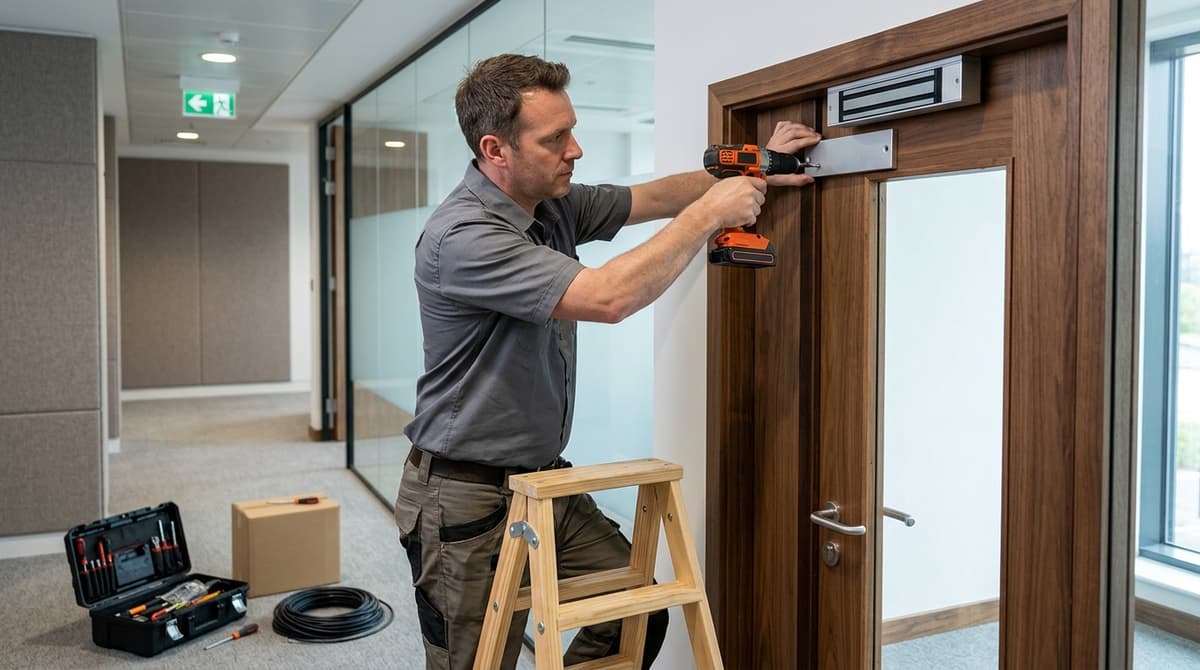
Get the sequence wrong on a maglock and you'll know it fast: either the door doesn't hold, or it fails to release when the fire alarm sounds. Installing one properly comes down to four decisions taken in order.
First, confirm the door will actually take a surface-mounted magnet. Second, calculate the holding force the opening needs — 360kg or 1000kg class, depending on door mass and use. Third, match the bracket (L, Z or U) to the frame profile and door swing.
Fourth, wire the release correctly: on any door forming part of an escape route, that means fail-safe, interfaced to the fire alarm system per BS 7273-4, never fail-secure. Nail those four and what's left is fixings, gap tolerance and a signed-off test. Miss one and a callback is built into the job before the PSU is even switched on.
Maglock Installation Guide: Force, Brackets, Wiring and Fire Compliance
Correct maglock installation means matching holding force to the door, choosing the right bracket for the frame, and wiring fail-safe into the fire alarm circuit wherever the door sits on an escape route. Get any one of those wrong and you either have a lock that won't hold under load or, worse, a fire door that stays locked when the alarm sounds.
Holding force: match the lock to the door, not the other way round
Holding force is rated in kilograms and must be checked against the door leaf, its width and whether it's single or double. Euro CCTV's range includes a 360kg double-door maglock suited to lighter internal doors and a 1000kg double-door maglock for higher-force applications and heavier doors — the dossier for the 1000kg unit describes it as suitable for a wide range of door types, so check the specific datasheet rather than assuming fire-rated suitability by default. Oversizing holding force slightly is generally cheaper than a callback later; undersizing risks the door being forced or the lock chattering under normal use. Neither figure replaces the door manufacturer's own guidance, since leaf construction and hinge condition affect real-world performance.
Bracket selection: L, Z, U — and why the bracket matters as much as the lock
Bracket choice is dictated by which way the door opens and how much clearance the frame gives the armature plate, not by preference. An L-bracket suits doors with enough frame face for a direct fix on a standard swing; a Z-bracket drops the lock down and out where the frame is too narrow or an overhead door closer is in the way, a common fix on a maglock z bracket installation; a U-bracket wraps around glass or narrow-stile aluminium doors where there's no flat fixing face at all. Which of L or Z suits an in-swing versus out-swing door depends on frame reveal and closer position on site, so check the specific door before drilling rather than applying a fixed rule.
How is a maglock actually installed?
A maglock installation is a sequence of four decisions, not a single fitting job: check the door can take a surface-mounted magnet, size the holding force, match the bracket to the frame, then wire the release as fail-safe. Get that order right and the rest is fixings and testing; get it wrong and you end up with a door that won't hold shut or, worse, one that won't release in a fire. Most installer call-backs trace to bracket mismatch and fail-safe wiring, not the door survey or the force calculation.
The core install sequence
Start by confirming door swing — in-swing or out-swing — and frame material, because that single fact dictates whether an L, Z or U bracket is needed. An in-swing timber door with a deep frame reveal usually needs a different offset to an out-swing aluminium-framed door, which is why bracket profile is chosen after the survey, never before it.
The magnet body mounts to the frame header and the armature plate mounts to the door leaf, with a gap set to the manufacturer's tolerance — check the datasheet for the specific maglock model before drilling, as gap tolerance varies between a compact single-door unit and a heavier double-door version. A Maglock Mounting Bracket in aluminium alloy is built for inward-opening doors and is one option where the survey confirms that profile fits; it's stocked and shown IN_STOCK on the trade site, but bracket choice always has to follow the door check, not precede it.
Holding force is sized to the door, not guessed. Products like the 1000kg double door maglock are typically installed above double doors and integrate with access control controllers, card readers, biometrics and intercom door entry — a heavier pairing than the 360kg double door maglock, which is more commonly paired with keypads, card readers and push-to-exit buttons above lighter double-door sets. Choosing between them is a function of door mass, expected force applied by users, and whether the opening carries fire-exit traffic — not a default to the biggest lock available.
Bracket type by frame profile
| Bracket |
Typical use case |
| L bracket |
Standard out-swing door, shallow frame |
| Z bracket |
In-swing door needing extended offset from frame face |
| U bracket |
Narrow-stile aluminium frames, glazed doors |
A maglock z bracket installation is the one installers get asked about most because the Z profile is what corrects for in-swing doors where the magnet can't sit flush to the header — get that offset wrong and the armature plate won't meet the magnet face square, which reduces holding force regardless of the lock's rated capacity.
Wiring the release: fail-safe, never fail-secure
A maglock must be wired fail-safe, releasing on loss of power, and tied into the fire alarm relay so the door frees on activation. This is the step that separates a compliant installation from a liability: fail-secure wiring on a magnetic lock defeats the purpose of an emergency exit and is the single most common reason a maglock job gets flagged on inspection. Whatever model is on the door — whether it's referenced as an ML600, M62, M32, model 270, or from a brand like ASSA ABLOY, RCI or Visionis — the fail-safe requirement doesn't change with the badge on the housing; it's a function of how the lock is wired into the power supply and the fire panel, not the manufacturer.
Because maglock installation cost is driven by bracket choice, cabling run length to the fire panel, and whether a request-to-exit device or break-glass is also being fitted, it varies job to job — a trade account gives visibility of current bracket and lock pricing rather than a figure quoted here. Euro CCTV supplies the maglocks and brackets; wiring into the fire alarm system itself is fire-system integration work for a qualified installer to carry out and verify against the building's own fire strategy.
How much holding force do I actually need?
Match the maglock's rated holding force to the door's weight, its width (leverage), and how the door gets used — never just buy the biggest kg figure on the shelf. Manufacturers rate maglocks in common bands of 300kg, 360kg and 1000kg static holding force, but that number is measured with the door closed flush and the load applied dead-on, not at the leading edge.
A wide door turns the same weight into far more leverage against the lock face, so the rated figure alone can be misleading.
What actually drives the force calculation
- Door weight and width: leverage increases with distance from the hinge, so a heavy fire door on a wide leaf needs more rated holding force than the same weight on a narrow door — width, not just weight, is what pushes you up a band.
- Single vs double door: a double-leaf opening splits the load across two armature/lock pairs rather than loading one lock with the full width. A 360kg double door maglock suits many double-leaf openings, and a heavier opening may call for a 1000kg double door maglock instead — check the specific product datasheet for the rated figure per leaf before specifying either.
- Usage and abuse: high-traffic doors, doors prone to being slammed, or external doors exposed to wind loading all warrant a margin above the bare calculated figure rather than a lock sized to the minimum.
- Mounting method: an inward-opening door using a Z or L bracket introduces a small offset between the door face and the lock body, which affects how squarely the armature plate meets the lock. Check this against the bracket manufacturer's fitting guidance rather than assuming it.
The safe approach is to size up from the calculated minimum, not down to it. A lock running comfortably within its rated band tends to be more tolerant of door sag, alignment drift and daily wear than one sized exactly to the number on a spec sheet.
Which bracket — L, Z or U — fits my door?
The bracket exists to solve one problem: get the magnet and armature meet flush and parallel when the door's frame profile won't let you surface-mount the lock body directly. Fit the wrong type and the gap tolerance the lock needs to sense the armature properly becomes unachievable, or the door can't swing open past 90° without the armature catching the frame return.
Bracket selection by frame type
| Bracket |
Use case |
What it solves |
| L bracket |
Standard in-swing door, flat frame face with clearance above |
Drops the lock body down where the frame reveal is too narrow for direct fixing |
| Z bracket |
Out-swing door, or where the door needs to open past 90° without the armature fouling the frame |
Angles the armature plate so it clears the frame return |
| U bracket |
Narrow-stile aluminium or glass doors (shopfront-style) |
Wraps the lock body around a thin stile where there's no flat face to fix into at all |
An L bracket is typically the starting point on a timber or steel in-swing door where the frame has a plain, flat reveal above the leaf. A Z bracket often earns its keep on out-swing doors, or anywhere the leaf needs to travel past a 90° arc, since it kicks the armature plate away from the frame return that would otherwise stop the door short.
A U bracket is really a stile clamp rather than a spacer. It's the option for narrow aluminium shopfront framing or glazed doors, where there's no flat timber or steel face deep enough to take fixings at all. Bracket choice depends on door swing and frame reveal, so treat the table above as a starting point rather than a fixed rule for every frame you meet on site.
Whichever bracket you're specifying, treat it as a separate line item from the lock itself. Euro CCTV stocks a Maglock Mounting Bracket.
How do I wire a maglock as fail-safe for fire compliance?
On doors forming part of a fire escape route, a maglock must be wired fail-safe, so that removing power releases the door, and the fire alarm panel must be able to cut that power directly rather than through the access control software. Get this wiring decision wrong and the door stays locked in the one scenario it must not — during a fire alarm activation. BS 7273-4 governs this interface, and it's worth treating as a compliance requirement rather than an installation preference.
The wiring principle
Fail-safe works because a maglock has no mechanical bolt to retract or spring back — it holds purely through electromagnetic attraction between the lock body and the armature plate. Cut the 12V or 24V supply and the magnetic field collapses instantly, releasing the door with no moving parts to jam.
This is the opposite of a fail-locked electric strike. It's why maglocks are the usual choice on fire escape doors, provided they're wired correctly.
Where the fire interface sits
The fire alarm system must break the maglock's power supply through a dedicated relay or interface unit, not by sending a software command to the access control panel. BS 7273-4 (referenced widely across UK fire and access control guidance) sets out this principle for escape-route release mechanisms.
Fire detection and alarm systems that actuate release mechanisms on escape routes need a direct, hard-wired interface. A software-mediated release depends on the access controller staying powered and responsive during a fire — an assumption that shouldn't underpin a life-safety function.
Practically, that means:
- The fire alarm panel's relay output feeds directly into the maglock's power line (or into a dedicated power supply unit's fire input), cutting 12V/24V DC on activation.
- A break-glass or green manual release button is fitted at the door as a secondary local override, independent of the fire panel.
- The access control system may log the release event, but it must never be the only path that can remove power from the lock.